
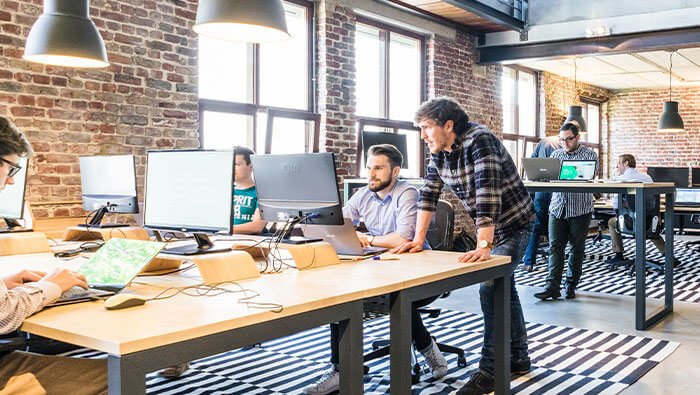

Why are we going back to the office?
She argued that the modern-day attachment to “presenteeism” goes back to earlier days of mass industrial production when workers were required to clock in and clock out at the start and end of their working day. Now, given the advantages technology presents us with, this concept is outmoded when there are so many ways of assuring the productivity of your teams.
And, the last twelve months have shown us that people can be just as productive, if not more so, working remotely. Given the impact the pandemic has had on health, workers are also naturally reluctant to return to their offices. There is caution around using public transport, and a natural desire to ensure that firms have taken all possible precautions to make the workplace safe with Covid-19 still very much with us as we await the impact of the vaccination programme.
However, she missed out on some key areas that need to be raised before we can agree that staying with remote working over life in the office is the way forward for most people.
Claire said that although there are people who miss the interaction of office-life, working with their colleagues, the impromptu conversations that often bring about solutions, this isn’t the real reason we are being encouraged back. The real reason, she asserts, is “to keep Pret-a-Manger open.”
The economic impact of home working
It’s easy to be dismissive of our need for a ready-made sandwich when weighed against the human cost and suffering of Covid-19. However, much more is at stake than that. Thousands of businesses depend on trade generated by office workers. Not just the fast-food chains, but family-run restaurants, pubs, bars, shops, theatres and cinemas are all driven, in large part, by office trade. Many of these businesses would go to the wall without the support of office workers. Certainly, they wouldn’t survive from Monday to Friday if they were dependent solely on “non-office” trade.
As our experience of lockdown has shown, the disappearance of such jobs will deprive many people of their livelihoods, with little prospect of other work to replace them in the short to medium term. And with that comes the knock-on effects to health and mental wellbeing that are so much harder to measure than those who have caught, suffered, and tragically died from the effects of Covid-19.
In addition, these jobs are often what young people have relied on at the start of their working lives. Not only have they earned the money they need to live from these jobs, but they have also built the confidence and resilience that comes from working in a team and interacting with the public. And, as has been well documented, it is the young who have, in so many ways, born the societal brunt of Covid-19, through their inability to socialise, the reduced opportunity to earn a living, and the impact on their education.
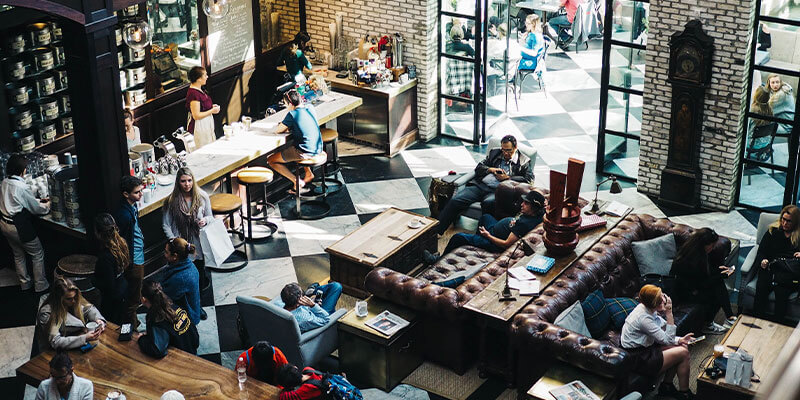
Working effectively
Claire made the undeniable assertion that companies have to ensure they provide their employees with safe working conditions in the office. And, if you can’t do that without significantly diminishing the whole point of returning to the office, why bother? In fact, it would be reckless to do so. However, what also needs to be thought through is how you truly make working remotely not only productive, but a satisfying experience too.
Whilst many companies would agree that remote working during the pandemic has had little impact on productivity (it may even have enhanced it for some, although certainly not all), how many have thought through how you create a working environment that goes some way to replicating the advantages working in a physical team environment generally gives us?
Key to this is the line manager relationship. Not only does thought have to be given to the usual dimensions of career progression and performance management, but remote working will increase the responsibility line managers have for checking in on the mental and physical wellbeing of their line reports. How many are ready and equipped to do this?
There is no doubt that meetings on Zoom or Microsoft Teams tend to be focused and efficient. They can also be cold and formulaic. Gone is the natural small talk that took place at the start and end of the meetings. Now, we sit with “mute” turned on to block out background noise and click out of the meeting as soon as it’s finished. Your objectives may be met, but how do people feel about their experience? Also, without thought, it can be easy for the most senior person to dominate discussion in online meetings; power differentials need to be addressed, ensuring subordinates are given the opportunity to not only make contributions, but ones which are acknowledged and valued. During the pandemic, much has been written about the concept of psychological safety, a concept which needs particular focus and skill when you are seeking to create it in an online environment. Libby Purves wrote in a Times leader: “…while video has been a 2020 godsend, it removes important factors: the ability to read faces and attitudes accurately, to catch a dissenting eye privately across the room or to spot who would chip in constructively but might hesitate.”
Lastly, we have all grown used to online working as a consequence of it being forced on us by circumstances outside our control. Businesses had not planned for this revolution in workplace practice. The things we take for granted when we see people, when we work alongside them, can be easily forgotten when they are out of sight. During lockdowns, many of us worked from home with partners, kids, perhaps grandparents in attendance. While that may have presented distractions, it gave us the comfort of human presence. As and when the world returns to normal, so people working from home will increasingly find themselves alone for 6 to 9 hours a day. That can become isolating, mentally demanding and lead to drift, a drop in productivity and an impact on how positive we feel about our work – especially if the physical workplace norms are forgotten.
- Keeping in touch – when and how do you want your team to update you generally? When and how will you do the same? How often and using what platform? How will you involve them in team meetings? How often – and in what circumstances – do you want them to come into the office?
- Working hours and practices – how flexible are you in terms of when and where they work? What is the protocol for sickness and holiday? (NB Typically, this should follow the same general process as working in the office, but this needs to be spelled out clearly.)
- Responsibilities and objectives – how do you want your teams to update you on what they are working on? When and how do they need to flag any issues? How will you manage review meetings?

Here’s the link to the rest of the article. It’s well worth a read: Click here.
In conclusion, there is much that is desirable about remote working. Certainly, it affords the opportunity of a better work life balance. It could reduce business overheads and the strain on our transport infrastructure. But, done without thought, it comes with potential costs to the individual, the company, and to our town and city centres. The shift from the present office-based culture is seismic. Planning for such a shift needs to reflect that.
Recent Comments